Where to Travel in India Beyond the Taj Mahal
By Vaidehi · July 2, 2026 · 10 min read
A region-by-region guide to the India most first-time travelers never realize exists.
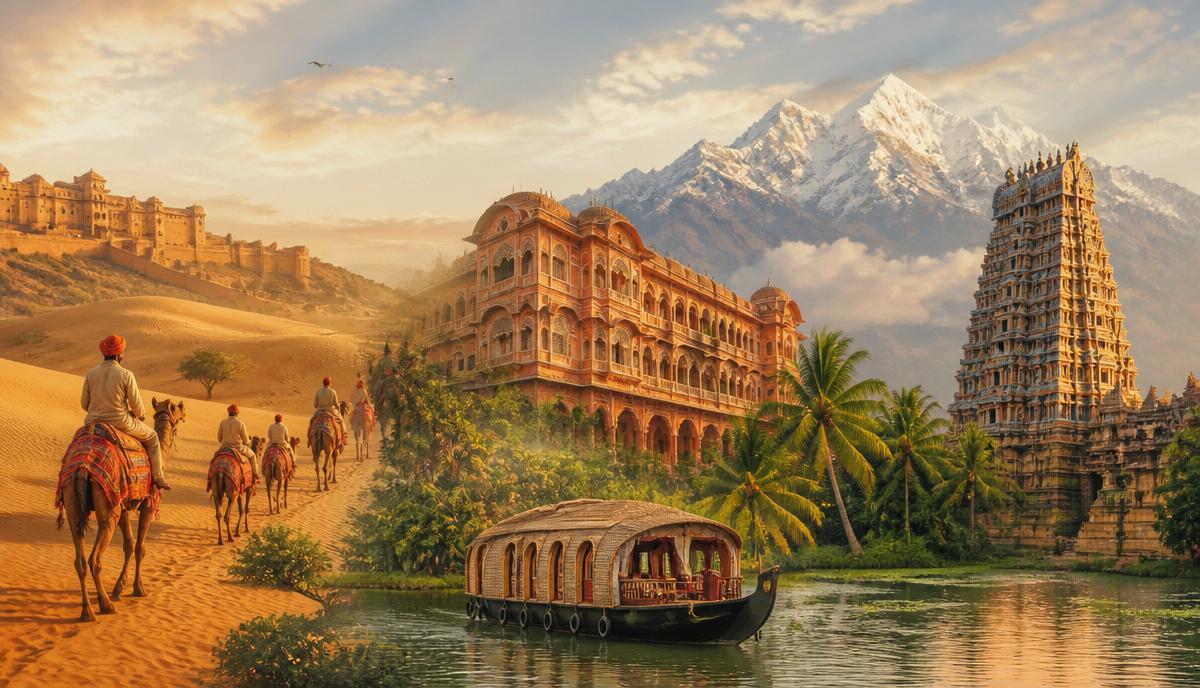
Most people know about the Taj Mahal. Far fewer realize it is one of hundreds of extraordinary monuments spread across a country where every region has its own dynasty, faith traditions, architecture, food, language, and rhythm.
That is what makes India so fascinating and so hard to summarize. It is not one kind of trip. It is many countries inside one country, stitched together by history, culture, food, faith, family, and memory.
If you are curious about India but only know the usual images, this guide is a starting point. It is not a complete list, because India could never fit into one article. But it is a glimpse of the India beyond the Taj Mahal: sacred, royal, coastal, ancient, modern, rugged, peaceful, and full of stories.
North India: Sacred Places, Empires, and Living History
Begin in Amritsar, in Punjab, where the Golden Temple sits serenely in the middle of a sacred pool. It is the holiest site in Sikhism and one of the most peaceful places you can visit. Everyone is welcome there, regardless of religion.
There is something deeply moving about the Golden Temple. It is not only beautiful. It feels alive with devotion, humility, and service. For many travelers, it becomes one of the most memorable stops in India.
Move south to Delhi, India's chaotic and magnificent capital. Delhi can overwhelm you at first, but it is also one of the best places to understand India's layers. The Red Fort, a vast sandstone complex built in the 1600s, was once home to Mughal emperors. Nearby, the Qutub Minar, a 73-meter tower covered in intricate carvings, was started in 1193 and still stands remarkably well preserved.
Then comes Agra, and yes, the Taj Mahal. Built by Emperor Shah Jahan as a monument to his late wife, it is every bit as stunning as it looks in photos. But do not rush out of Agra too quickly. The Agra Fort next door is equally impressive and often far less crowded.
A short drive away, Fatehpur Sikri is a ghost city, a fully built Mughal capital that was abandoned just 14 years after completion. Walking through it feels like stepping into a time capsule.
Further east, the temples of Khajuraho in Madhya Pradesh are famous for their extraordinarily detailed carvings, a celebration of life, love, and devotion built between 950 and 1050 CE. For travelers who think of temples only as religious places, Khajuraho offers something more layered. It shows art, philosophy, beauty, and human expression carved into stone.
Rajasthan and Gujarat: Palaces, Desert Forts, and Sacred Coastlines
Rajasthan is where India often feels like a fairy tale.
In Jaipur, the Amber Fort glows golden in the morning light. The City Palace in the center of town is still partly home to the royal family. And right in the heart of the old city stands the Hawa Mahal, the Palace of Winds, a five-story honeycomb of nearly 1,000 tiny windows built so royal women could watch street life below without being seen.
Jodhpur's Mehrangarh Fort looms over the city, its walls so massive they seem to grow out of the rock itself. It is one of those places where you feel the scale of history. You stand above the blue city and suddenly understand why forts were not just buildings. They were power, protection, pride, and identity.
Jaisalmer, deep in the Thar Desert, is a fort city built of golden sandstone, where people still live inside the fort walls today. The desert changes the pace of travel. The light is softer, the evenings feel quieter, and the landscape makes you slow down.
Udaipur may be Rajasthan's most romantic stop. The Lake Palace, a white marble palace that appears to float on Lake Pichola, was once a royal summer retreat and is now a hotel so beautiful that people book it just to have a meal there.
Cross into Gujarat and you will find two very different treasures.
Dwarka, on the western coast, is one of Hinduism's most sacred cities and is believed to be connected to the ancient kingdom of Lord Krishna. It brings together faith, mythology, sea air, and a feeling of old devotion that is hard to explain until you are there.
Rani ki Vav, a UNESCO-listed stepwell near Patan, is unlike anything most Western visitors have ever seen: an elaborately carved underground staircase that descends seven stories into the earth, every inch covered in sculpture.
It is practical and beautiful at the same time. That is one of the things I love about India. Even something built to store water can become a masterpiece.
Maharashtra: Forts, Caves, Pristine Beaches, and the Maratha Story
Maharashtra is Maratha country, a proud warrior culture that built dozens of clifftop forts across the Sahyadri mountain range.
Raigad Fort was the capital of the Maratha Empire under the legendary king Chhatrapati Shivaji. These forts are not polished tourist traps. They are rugged, dramatic, and deeply tied to Indian identity.
For me, this part of India feels especially powerful because it is not only about architecture. It is about resistance, courage, mountain landscapes, monsoon clouds, and stories that many visitors outside India have never heard.
Nearby, in the hills near Aurangabad, now officially Chhatrapati Sambhajinagar, the Ajanta and Ellora caves are among the most remarkable things human hands have ever made.
Ajanta is a series of Buddhist cave monasteries carved into a horseshoe-shaped cliff, filled with 2,000-year-old murals that still hold their color.
Ellora goes further, with 34 caves spanning Buddhist, Hindu, and Jain traditions. The Kailasa Temple there is a massive temple carved top-down from a single rock.
Not built. Carved. Out of one mountain.
And what can I say about Maharashtra's pristine beaches? Its Konkan coast is one of India's most underrated treasures, with quiet beaches, swaying coconut palms, red laterite cliffs, and fishing villages that still feel untouched by mass tourism.
From Ganpatipule and Tarkarli to Diveagar and Harihareshwar, this stretch of coastline offers a slower, softer side of India where the sea feels calm, local, and deeply peaceful.
For travelers who only imagine India as crowded cities and monuments, the Konkan coast can be a beautiful surprise.
East India: Enlightenment, Stone Chariots, and Old-World Charm
East India has a very different rhythm.
In Bihar, Bodh Gaya is where the Buddha sat under a fig tree and attained enlightenment around 500 BCE. The Mahabodhi Temple complex built around that spot is one of the holiest places on earth for Buddhists, and a profoundly moving experience even for non-religious visitors.
There are places in the world where silence feels different. Bodh Gaya is one of them.
On India's eastern coast in Odisha, the Konark Sun Temple is a 13th-century marvel designed as a giant stone chariot of the sun god, with 24 intricately carved wheels and horses pulling it forward. Every inch of the stone tells a story.
And then there is Kolkata, a city unlike any other in India.
It moves at its own unhurried pace, where intellectuals linger over tea, street-side bookshops spill onto sidewalks, and century-old trams still rattle through the streets. Kolkata has a distinctly old-world charm, with grand colonial architecture sitting comfortably next to bustling markets, art galleries, and those iconic yellow Ambassador taxis that instantly remind you of vintage New York.
It is a city that is deeply modern in its thinking, yet completely unbothered about slowing down.
Kolkata is not always the first place travelers choose on a first India trip, but for people who love literature, history, food, art, and layered cities, it has a soul that is hard to forget.
South India: Living Temples, Royal Palaces, and the End of the Subcontinent
South India is another world within India.
Karnataka is home to two very different wonders.
Hampi was once one of the largest cities in the world, the capital of the Vijayanagara Empire in the 1400s. Today it is a UNESCO site of ruins spread across a surreal boulder-strewn landscape: temples, market halls, elephant stables, and royal pavilions slowly being reclaimed by nature.
It feels like nowhere else on earth.
Mysore's royal palace is a completely different experience, ornate, colorful, and almost theatrical. Every Sunday evening, it lights up with nearly 100,000 bulbs. It is unlike the grand but more austere Mughal architecture of the north.
Further south in Tamil Nadu, the Meenakshi Temple in Madurai is one of India's great living monuments. It is not a ruin, but an active temple visited by thousands of devotees every day. Its towering gateways, covered in thousands of hand-painted sculptures of gods and mythological figures, are overwhelming in the best possible way.
At the very tip of India, where the land runs out, is Kanyakumari, the point where the Arabian Sea, the Bay of Bengal, and the Indian Ocean meet. On clear days, travelers come here to watch sunrise and sunset from the same town.
It is, quite literally, the end of the subcontinent, and one of those places that stays with you long after you have gone home.
How to Think About Traveling Through India
The biggest mistake travelers make with India is trying to see too much too quickly.
India is not a country to rush through just because the map makes a route look possible. A place that looks close on paper may take longer because of traffic, roads, trains, weather, crowds, or simply because India moves on its own rhythm.
That does not mean India is too hard to travel. It means India rewards travelers who plan thoughtfully.
You do not need to see every region in one trip. In fact, you probably should not. A first trip to India is better when it has the right pace, the right expectations, and enough breathing room to actually feel where you are.
- Choose North India for forts, Mughal history, food, and the Taj Mahal.
- Choose Rajasthan for palaces, desert landscapes, and royal cities.
- Choose Maharashtra for caves, forts, beaches, and a powerful Maratha story.
- Choose East India for spirituality, art, literature, and old-world cities.
- Choose South India for temples, backwaters, palaces, beaches, and a softer tropical rhythm.
There is no single "right" India trip. There is only the India trip that fits your curiosity, comfort level, pace, and sense of wonder.
The India Beyond the Taj Mahal Is Waiting
The Taj Mahal deserves its fame. It is one of the most beautiful monuments in the world.
But India is not one monument. It is not one city. It is not one story.
It is the sacred stillness of the Golden Temple, the golden walls of Jaisalmer, the stone wheels of Konark, the caves of Ajanta and Ellora, the forts of Maharashtra, the old trams of Kolkata, the living temples of Tamil Nadu, the palaces of Mysore, the beaches of Konkan, and the place where three seas meet at Kanyakumari.
It is ancient, modern, overwhelming, gentle, royal, spiritual, coastal, colorful, and deeply human.
That is the India I wish more travelers knew.
And once you see even a small part of it, you understand why one trip is never really enough.