Will I Get Sick in India? An Honest Guide to Food and Water
By Vaidehi · July 18, 2026 · 9 min read
Food safety is one of the biggest concerns new travelers face when they plan a trip to India. "What should I avoid?" "Will I get sick if I eat this?" "Is the water safe?" These are the questions I've answered most often on my trips to India with my American coworkers. And they're valid concerns for anybody visiting any city for the first time. I had the exact same questions when I visited Barcelona and Lisbon recently. In Barcelona I worried about the tap water and about a possible allergic reaction to the raw fish in ceviche. Same with Lisbon: I worried about the water and the street food. India is no exception. You do need to be a little extra careful in India, but that doesn't mean you need to be afraid of every meal. The difference between those two is a careful routine.
A good rule of thumb: drink only sealed bottled water, eat freshly cooked food from busy kitchens, avoid ice at any cost (even in cocktails), and don't eat food that's been sitting around for a while. That routine will save you from most unfortunate incidents. No one can guarantee you won't get sick. A good routine lowers the odds substantially.
Will I get sick from the food in India?
Probably not seriously, if you follow a few rules. The common scenario isn't a hospital visit. It's a day or two of an unhappy stomach, and it usually traces back to water, raw food washed in that water, or cooked food that sat out too long. Freshly cooked, served hot, from a busy kitchen: that combination does most of the protective work for you.
The single best habit is what I call the turnover rule. Eat where lots of people are eating, at the hour they're eating. A restaurant that's full at 1pm is cooking continuously, which means nothing on your plate has been sitting around. An empty restaurant at 4pm is serving you whatever was made for the lunch rush. The busy place always wins, even when the empty place looks cleaner.
One more thing worth knowing: India has the deepest vegetarian food culture in the world. Traditional Indian cuisine rarely adds milk or cheese to curries, and rare or raw meat is not a delicacy. It's simply not part of the cuisine. That eliminates a lot of the variables that come with meat and dairy.
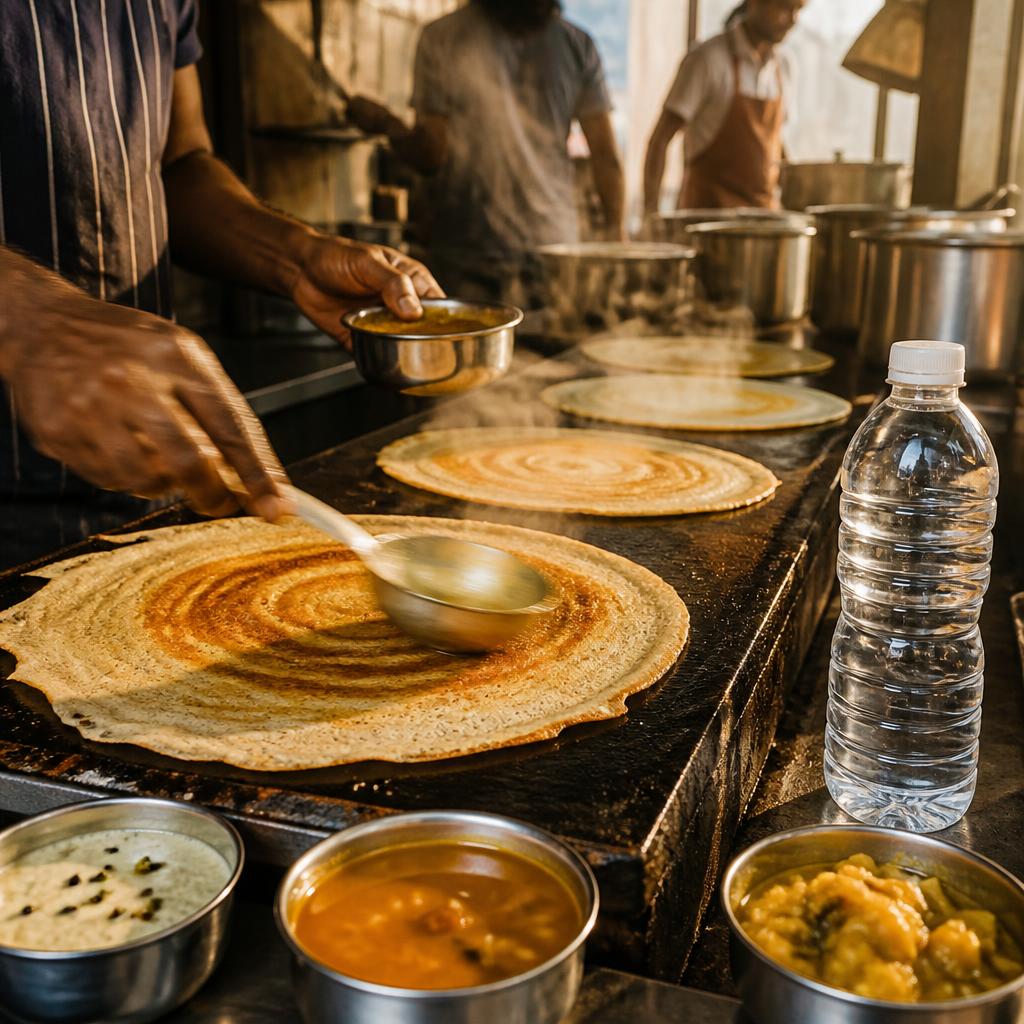
The second habit comes straight from the CDC's standard advice for travelers, and it's older than all of us: boil it, cook it, peel it, or forget it. Indian food works enormously in your favor here, because the everyday food of the country is cooked hard and served hot. Dals simmer for hours. Curries bubble. Breads and rotis come off a hot tawa in front of you. A dosa is cooked on a griddle hot enough to make it crackle. The risky category isn't Indian food. It's raw food: salads, uncooked garnishes, cut fruit sitting on a plate, anything rinsed in tap water and served cold. Fruit you peel yourself, like a banana or an orange, is fine anywhere, and so is coconut water straight from the shell.
There's an irony in all of this. Centuries ago, Western traders sailed oceans in search of Indian spices, and now travelers worry about getting sick from the very food that drew the world to India. If you choose mindfully, you'll cherish the food and the moment, and you won't miss out on the hospitality or the absolute deliciousness of Indian cuisine.
Can you drink the tap water in India?
No. Don't drink tap water anywhere in India, not in any city and not at any hotel, no matter how nice the hotel is. This is the one absolute rule in this entire guide. Everything else is a matter of degree and judgment. This one isn't. Drink sealed bottled water or filtered water from a source you trust.
Sealed bottled water is everywhere in India, and it's cheap. Brands like Bisleri, Kinley, and Aquafina are sold at every shop, hotel, and railway platform. Two habits matter. First, check that the cap actually cracks when you twist it. A loose cap on a full bottle is a refilled bottle, and you hand it back. Second, look for the MRP printed on the label. That's the maximum retail price, and it's legally binding, which makes bottled water one of the few things in India nobody can overcharge you for. If a vendor asks for more than the printed number, point at the label and smile.
Well-run hotels increasingly filter their own water, usually with reverse osmosis systems, and will refill your bottle at the front desk or leave glass bottles in your room. That water is fine. And hot drinks are your quiet ally here: chai and coffee are made with water that has been properly boiled, which is why a roadside chai is often a safer bet than a glass of anything cold.
Here are the water rules in one place, because this is the part worth screenshotting.
| Situation | What I'd do |
|---|---|
| Tap water | Never drink it. Anywhere, at any hotel, in any city. |
| Sealed bottled water | Yes. Check that the cap cracks when you open it, and check the printed MRP on the label. |
| Filtered water at a good hotel | Yes. Most well-run hotels filter their water in-house. Ask if you're unsure. |
| Ice | Avoid it. It may be fine at upscale hotels and restaurants that make ice from filtered water, but skipping it is the safer call. Ask about filtration if you're unsure, and skip it everywhere else. |
| Hot chai and coffee | Yes. The water is boiled. This is the easiest safe drink in the country. |
| Brushing your teeth | Use bottled or filtered water, at least for the first week. Keep a bottle by the sink. |
How do I choose restaurants and hotels with better hygiene?
For restaurants, my heuristics are simple and they travel well. Busy beats empty. Peak hours beat off hours. A place that does one kind of food well beats a menu offering Italian, Chinese, and Indian on the same laminated page. Food should arrive hot enough to steam. And don't drink the water restaurants pour by default; always ask for a sealed bottle.
In India, especially in the big metro cities, you'll find a huge range of restaurants: small roadside street stalls, small and mid-size local restaurants crowded with regulars, American chains like McDonald's and Taco Bell, and polished, expensive places with great ambiance and craft cocktails. Aside from the street stalls, all of these are safer choices. As a rule, the fancier the place, the better the hygiene. But nothing is guaranteed. I once got food poisoning at a Michelin-starred chef's restaurant in New York City.
When it comes to your stay, choose hotels with well-run kitchens and in-house water filtration. You'll find every kind of hotel in India, from small budget properties to true luxury hotels and villas. The trustworthy ones have well-trained staff and a central location. Always read recent online reviews before booking anything.
When I vet hotels for clients, the kitchen is part of what I'm checking, along with the water setup, the breakfast, and how the staff responds when something goes sideways at 9pm. A hotel with a good breakfast solves a third of your food decisions before you've made any. You start every day with a meal you don't have to think about, and you head out steady instead of hungry and improvising. And in your first two or three days, eat at your hotel and at established restaurants, then widen the circle as your stomach and your confidence settle in. In my experience planning trips for first-time American travelers, the people who ease in during days one through three eat far more adventurously by day ten than the people who tried to do everything at once.
Hygiene and price are also more connected than the internet admits, which is worth understanding when you look at what hotels cost across India. Your dollars go far there. The $100 to $200 a night that buys a mid-range Hilton or Marriott in the US buys a five-star luxury hotel in India, and at that level hygiene and food will be the least of your concerns. You'll be treated like royalty, and you'll want to go back again and again.
Is street food safe in India?
Sometimes, and it also includes some of the best food in the country. But street food is the highest-variance category there is, and I don't recommend it in your first few days. If you want it, and I hope you do, there's a way to do it that keeps the odds on your side.
Go with someone who knows the stalls, ideally a guided food walk in cities like Delhi or Mumbai, where a guide takes you to vendors they eat at themselves. Even with a guide, choose items cooked hot in front of you: things straight out of the fryer, off the griddle, out of the tandoor. Skip the raw add-ons, which is where the trouble usually lives: fresh chutneys, yogurt sitting at room temperature, cut fruit, anything cold. A samosa pulled from bubbling oil is a fundamentally different risk than a cold chaat dressed with three raw sauces, even from the same stall. Avoid ice and watery drinks at any cost. Buy bottled water from a convenience store when you can. If you do buy water at a street stall, check that the cap is tightly sealed. Sometimes people sell refilled bottles, and you don't want those.
I'll be honest with you though: some of my favorite meals in the world are street food, and I still choose stalls exactly the way I just described. Growing up there doesn't make you immune. It makes you selective.
What should I pack, and what if I do get sick anyway?
See a travel clinic or your doctor four to six weeks before you fly, and treat the CDC's India destination page as your starting authority. I'm not a doctor, and nothing in this article is medical advice. As of July 2026, that page is where the current vaccine and medication guidance lives, and a travel clinic will tailor it to you.
In your bag, the short list matters more than the long one: oral rehydration salts, any medication your doctor specifically recommends for traveler's stomach, and your regular prescriptions in their original packaging. If you forget the rehydration salts, don't worry. Every pharmacy in India sells ORS sachets over the counter, pharmacies are on nearly every commercial street, and the pharmacist has had this exact conversation a thousand times.
If your stomach does turn, here's the realistic script. Most cases pass in 24 to 48 hours with rest, fluids, and ORS. Cancel the day, order plain food from the hotel kitchen, and let it pass. This is what the buffer day is for. Call a doctor if there's a high fever, blood, or symptoms that push past a couple of days. In major cities, a good hotel can have a doctor come to your room, often the same day, and this is one of the places where the hotel you chose earns its rate. That, by the way, is a big part of why I care so much about which hotels go on your itinerary in the first place.
Common Questions About Food and Water in India
Can I brush my teeth with tap water in India?
Use bottled or filtered water for brushing, at least for your first week. Plenty of long-term travelers eventually brush with tap water, but on a two-week trip there's no prize for adapting early. Keep a bottle by the bathroom sink so the habit runs on autopilot.
What is Delhi belly, exactly?
Delhi belly is the traveler's nickname for traveler's diarrhea: an upset stomach, usually from bacteria in water or food, that typically resolves in 24 to 48 hours. Treat it with rest, fluids, and oral rehydration salts, and see a doctor if you have a high fever or it lasts longer than a couple of days.
Can I eat salad in India?
I'd skip raw salads outside high-end hotel kitchens, since raw vegetables are typically rinsed in tap water. Cooked vegetables are everywhere in Indian cuisine and are the better choice. If you're craving raw produce, fruit you peel yourself is the safe version of the same urge.
Is vegetarian food safer in India?
Often it's the simpler bet. No other country does vegetarian food better than India, in my opinion. Vegetarian dishes are cooked at high heat, the variety is enormous, and there are fewer variables in the chain between kitchen and plate. Meat is fine at busy, reputable restaurants. India doesn't really serve undercooked meat anyway.
Should I take any medication before my trip to India?
That's a conversation for a travel clinic or your doctor, not for a blog. The CDC's India page lists current recommendations, and a clinician will tailor them to your health and your route. Book that appointment four to six weeks before you fly.
What preparation actually buys you isn't immunity. It's smaller stakes. The difference between a prepared traveler and an unprepared one usually isn't whether something happens. It's whether it costs an afternoon or a week. When I go back to India after months in Texas, I follow these rules too. Growing up there built my palate, not a force field, and a stomach that has spent years in the US is not the stomach I had at twelve. So I drink the sealed bottles, I eat where it's busy, and I take the first two days slow, in my own country. If I do it, you should feel zero embarrassment doing it.