Language and Logistics: Do You Need to Speak Hindi to Travel in India?
By Vaidehi · August 8, 2026 · 12 min read
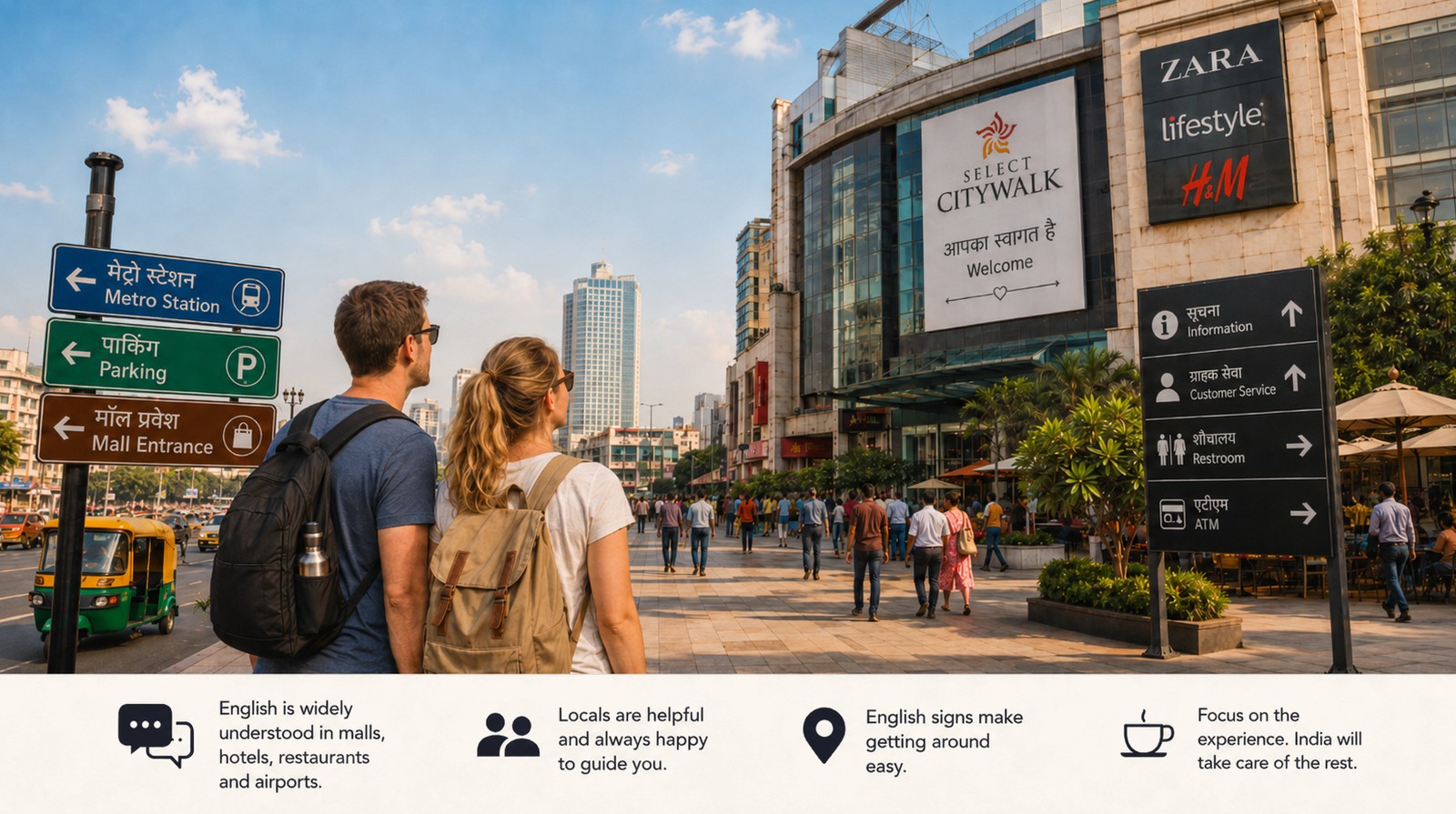
No, you don't need to speak Hindi or any Indian language to travel India well. English is spoken widely in airports, hotels, restaurants, and by most vetted drivers and guides. What you need is a plan for the logistics: arrivals, drivers, trains, tipping, and a calm way to handle it when plans change.
The question usually arrives quietly, near the end of a planning call. "I don't speak a word of Hindi. Is that going to be a problem?" I understand why it feels big. You've watched a video of a Delhi market and heard what sounded like six languages in thirty seconds. But of everything on your worry list, this is the one I can take off it fastest.
How many languages does India actually have?
India's constitution recognizes 22 official languages, and the 2011 census, the country's most recent, recorded 121 languages with at least 10,000 speakers, plus hundreds of dialects beyond that. About 1.4 billion people live inside that mix, and most of them move between two or three languages every day without thinking about it.
There's an old Hindi saying: kos kos par badle paani, chaar kos par baani. The water changes every couple of miles, and the speech changes every eight. It's barely an exaggeration. Drive a hundred miles in almost any direction and the language on the shop signs can change entirely, sometimes the script along with it.
Here's the American translation. Imagine Texas and Louisiana speaking different languages, written in different alphabets, with different film industries, and still sharing one currency, one rail network, and one obsession with the same cricket team. That's roughly what crossing an Indian state line is like.
What surprises Americans is not the number of languages. It's that the country runs anyway. A Tamil speaker and a Punjabi speaker who share no mother tongue will do business in English or Hindi and think nothing of it. Multilingualism isn't an achievement in India. It's the default setting, and it has been for centuries.
Will people speak English where you're going?
Yes, almost everywhere a first-time traveler goes. English is an official language of India at the national level, the working language of higher education, courts, and business, and millions of Indian children attend English-medium schools where it's the language of instruction from the first day of kindergarten.
The 2011 census counted well over 100 million English speakers, more than one in ten Indians, and the real number today is almost certainly higher, especially in cities. For scale, that's an English-speaking population larger than most countries. In hotels, restaurants, airports, and anywhere tourism touches, you can function entirely in English.
And here's the part no statistic captures. When someone in India realizes you don't share a language, the usual response isn't irritation. It's recruitment. A shopkeeper will wave over his niece who's studying for her board exams. A stranger at a train station will simply appoint himself your translator. I've watched this happen to my husband more times than I can count, and he has never once been left stranded mid-sentence.
One caveat worth knowing: Hindi itself is not universal. In Tamil Nadu or Kerala, English will actually serve you better than Hindi would. Which is convenient, because English is the one you already have.
What is Atithi Devo Bhava, and is it real?
Atithi Devo Bhava is a Sanskrit phrase from the Taittiriya Upanishad that translates to "the guest is god." India's Ministry of Tourism adopted it as the national hospitality motto, but it was a household teaching long before it was a campaign. In practice, it means guests are received with a seriousness that catches Americans off guard.
I grew up with it. When a guest came to our home, they ate first, they ate best, and the question was never whether we would feed them but whether they could possibly be convinced to eat more. That instinct scales up. It's why the front desk at a good Indian hotel remembers how you take your tea by day two. It's why the owner of a small local restaurant will walk you through the menu dish by dish and quietly adjust the spice for you. It's why a driver on a multi-day route starts treating your comfort as his personal reputation, because to him, it is.
I'll be honest about the limits, though. Atithi Devo Bhava is a culture, not a quality-control system. It doesn't vet your hotel, and it doesn't mean every person you meet in a tourist market has your interests at heart. The warmth is real. It just isn't a substitute for a plan.
How do airports, drivers, and trains work when you don't speak Hindi?
Better than you expect, because the systems that move travelers through India already run in English. Airport signage, boarding announcements, train tickets, and reservation charts all appear in English alongside Hindi and the state language. What actually matters is the plan: arrange your arrival pickup, book trains early, and keep everything confirmed on WhatsApp.
What should you expect at the airport?
Indian international airports are bilingual by design, and English is one of the two languages everywhere you look. Immigration officers speak English. So do airline staff, and the signs walk you from gate to curb without requiring a single word of Hindi.
The moment I actually plan around is the curb itself. My standing advice for a first arrival: have a pickup arranged in advance, with your name on a sign and the driver's number saved on WhatsApp before you board in the US. Major airports also have prepaid taxi counters where the fare is fixed and paid inside the terminal, which removes the negotiation entirely. And if your dates allow it, I schedule first-time travelers to land while it's still daylight. Everything is easier the first time when you can see it.
How do you work with a driver you can't fully talk to?
A private driver is the single logistics decision that changes an India trip most, and language is exactly why vetting matters. The drivers I work with speak functional English, which covers routes, timing, stops, and food. What it may not cover is nuance, and that's fine, because you don't need nuance from a driver. You need reliability.
WhatsApp closes the rest of the gap. Location pins instead of spoken directions. A typed message instead of a misheard one, since typed messages translate cleanly and accents don't. Over a few days a rhythm develops, and by day three most of my travelers communicate with their driver in a comfortable shorthand of place names, thumbs up, and chai stops.
Can you manage Indian trains without the language?
Yes, but the challenge isn't language. It's booking. Indian trains sell out weeks in advance on popular routes, and the reservation system is difficult to use from abroad, which is why train tickets are one of the first things I lock in when I plan a route. Tickets, station signs, and the reservation charts posted on each coach are all in English.
For a first trip, my usual shape is a driver for most legs and one classic train ride booked early, in an air-conditioned class like 2AC, where you have an assigned berth and no ambiguity about where you belong. Your coach number is printed on the ticket and displayed on the platform. The train experience is worth having. The train-as-your-only-transport experience is a second-trip decision.
How does tipping work in India?
Tipping in India is customary but smaller and far less formal than in the US. There is no 20 percent rule. Restaurant staff, hotel porters, housekeeping, drivers, and guides all appreciate a tip, and small amounts given directly do the work. Keep 10, 20, 50, and 100 rupee notes on you and tipping stops being a source of stress.
Two habits make it simple. First, check your restaurant bill before adding anything, because many Indian restaurants include a service charge already, and it's printed right on the bill. Second, for a driver or guide who's with you for several days, tip once at the end of the trip rather than daily. It reads as a considered thank-you instead of a running meter, and it matches how it's done.
Break large bills early and often. ATMs in India love dispensing big notes, and a pocket with nothing smaller than a 500 is the most common tipping problem I actually see.
How do you handle day-to-day communication?
Get an Indian SIM or eSIM working before or at arrival, keep WhatsApp active, and download Google Translate's offline Hindi pack before you leave home. Between English, gestures, and a phone screen you can show someone, day-to-day communication in traveler's India is rarely a real obstacle. A few words of courtesy carry you further than fluency would.
WhatsApp deserves special mention because it isn't an app in India. It's the infrastructure. Hotels confirm bookings on it, drivers send arrival updates on it, and the guide you meet on Tuesday will message you a restaurant recommendation on Thursday. If you set up nothing else, set that up.
Learn a handful of words, not for function but for warmth. Namaste as a greeting. Dhanyavad for thank you. That's plenty. The effort is noticed far out of proportion to the vocabulary, and it changes the temperature of an interaction instantly. One more thing nobody warns you about: the Indian head wobble, a soft side-to-side tilt, usually means yes, or okay, or I'm listening. It is not a no. Americans spend their first two days misreading it and their last two days doing it themselves.
What should you do when plans change?
Expect at least one change: a train delayed, a road slower than the map promised, a monument closed for a festival you didn't know existed. This isn't a failure of planning. India reroutes constantly, and a good plan is built to reroute with it. Slack in the schedule, everyone reachable on WhatsApp, and one person who is your first call.
In my experience planning routes for first-time American travelers, the difference between a bad day and a good story is almost never language. It's whether anyone is responsible for the fix. When I build an itinerary, the buffer is already in it: no tight same-day connections between a long drive and a flight, a flexible day in each major stop, and hotels and drivers who already know the whole route, not just their piece of it.
So decide before you land: when something shifts, who do you message first? If you're traveling with a planner, that's them. If you're on your own, it's your hotel front desk, which in India is a far more capable ally than most Americans expect. What you don't do is stand in a station concourse trying to solve it alone in a language you don't speak. That was never the plan, and it never has to be.
The honest part: where language actually gets hard
Everything above is true, and it has edges. Step well off the traveler's map, into small villages or local markets in less-visited regions, and English thins out fast. A driver whose English easily handles roads and restaurants may struggle with a conversation about a serious food allergy. And an Indian "yes" sometimes means "I heard you" rather than "I agree," which is a distinction that matters when you're confirming a 5 a.m. pickup.
None of this is a reason to stay home. It's a reason to prepare narrowly for the few moments that need it. If you have an allergy, carry a card explaining it in Hindi and in the language of the state you're visiting, and hand it over rather than saying it. Confirm anything time-critical in writing on WhatsApp, where translation is clean. And when an answer feels vague, ask once more, differently. I do this myself, in languages I speak fluently, because vagueness in India is often politeness wearing a disguise.
Common Questions About Language in India
Is English an official language of India?
Yes. English is an official language of the Indian government alongside Hindi, and it's the working language of the courts, higher education, and much of business. It isn't a foreign language in India. It's an Indian language with a couple of centuries of local history and its own distinct flavor.
Should I learn Hindi before my trip to India?
No. A handful of courtesy words is worth learning, but studying Hindi isn't necessary and in South India it wouldn't even be the right language, since states like Tamil Nadu and Kerala have their own. Spend that preparation time on logistics instead. It pays better.
Will my driver speak English?
A properly vetted driver will speak functional English: routes, timing, meals, and stops. Fluency varies, which is why I confirm important details in writing on WhatsApp, where messages translate cleanly. This is one of the specific things I check when I vet a driver for a client's route.
Do translation apps work in India?
Yes, and well. Google Translate supports Hindi and major regional languages, and the offline Hindi pack works without a signal. Typing works better than voice in noisy places. In practice most travelers use it far less than they expected to, because English covers nearly everything.
What if I end up somewhere nobody understands me?
It's rare on a first-timer's route, and it resolves faster than you'd think. Someone nearby who speaks English will usually be found for you, often enthusiastically. Show your destination written down or on a map, message your driver or hotel on WhatsApp, and let the local instinct for helping a guest do what it has always done.
India will hand you many things to feel on a first trip. Helplessness doesn't have to be one of them. The language barrier that keeps Americans home is, of all the worries I hear, the one that dissolves fastest on the ground, usually somewhere in the first afternoon, over a cup of chai you ordered in English.
If you'd rather have someone build the logistics around your actual dates, your actual route, and your actual worries, that is what I do.