Common India Tourist Scams and What Things Should Cost
By Vaidehi · August 8, 2026 · 11 min read
Most India tourist scams are small: an inflated rickshaw fare, a marked-up souvenir, a stranger steering you toward a shop that pays him commission. They cost you a dollar or two, not your safety. Pre-book your arrival, check fares on a ride app, haggle in markets, and decline help you did not ask for.
The fear underneath this question is rarely about the money. It's about feeling foolish, flying 8,000 miles and getting taken advantage of in your first hour. I'm Vaidehi, the planner behind CustomizeMyTrips. I grew up haggling in Indian markets, and I've also been the confused outsider in eleven other countries with my American husband. This guide comes from both sides of that experience.
What scams should I actually watch for in India?
The tourist traps you'll actually meet in India are persistent street hawkers, over-friendly strangers offering unrequested help with your luggage, drivers quoting inflated fares, and helpful locals steering you toward a shop or hotel that pays them a commission. Nearly all of them cost you money or time, not safety.
Street hawkers will follow you, sometimes for half a block, holding up whatever they're selling. This is persistence, not menace. One polite no, and keep walking. Stopping to explain yourself reads as an opening.
The one I want you to rehearse is the over-friendly helper. At airports and railway stations, someone may reach for your bags before you've said a word, or offer to walk you to a better taxi. Decline and move on, quickly and without apology. Unrequested help almost always comes with a bill attached, and occasionally with a detour.
The detour is its own category. A driver or a friendly stranger tells you your hotel is closed, or that the gate you want is shut for a ceremony, and offers an alternative. The alternative pays him a commission. The counter is simple: you pre-booked, so you already know your hotel is open. Call the front desk if you need to hear it.
This is why the first 48 hours of every itinerary I build are pre-booked: airport pickup, hotel, first-day driver. When nothing is left to arrange at arrivals, nobody at arrivals has anything to sell you. Many major Indian airports also run prepaid taxi counters, where you pay a fixed fare at a booth before you ever meet a driver.
How much should an auto rickshaw cost, and why does it depend on the city?
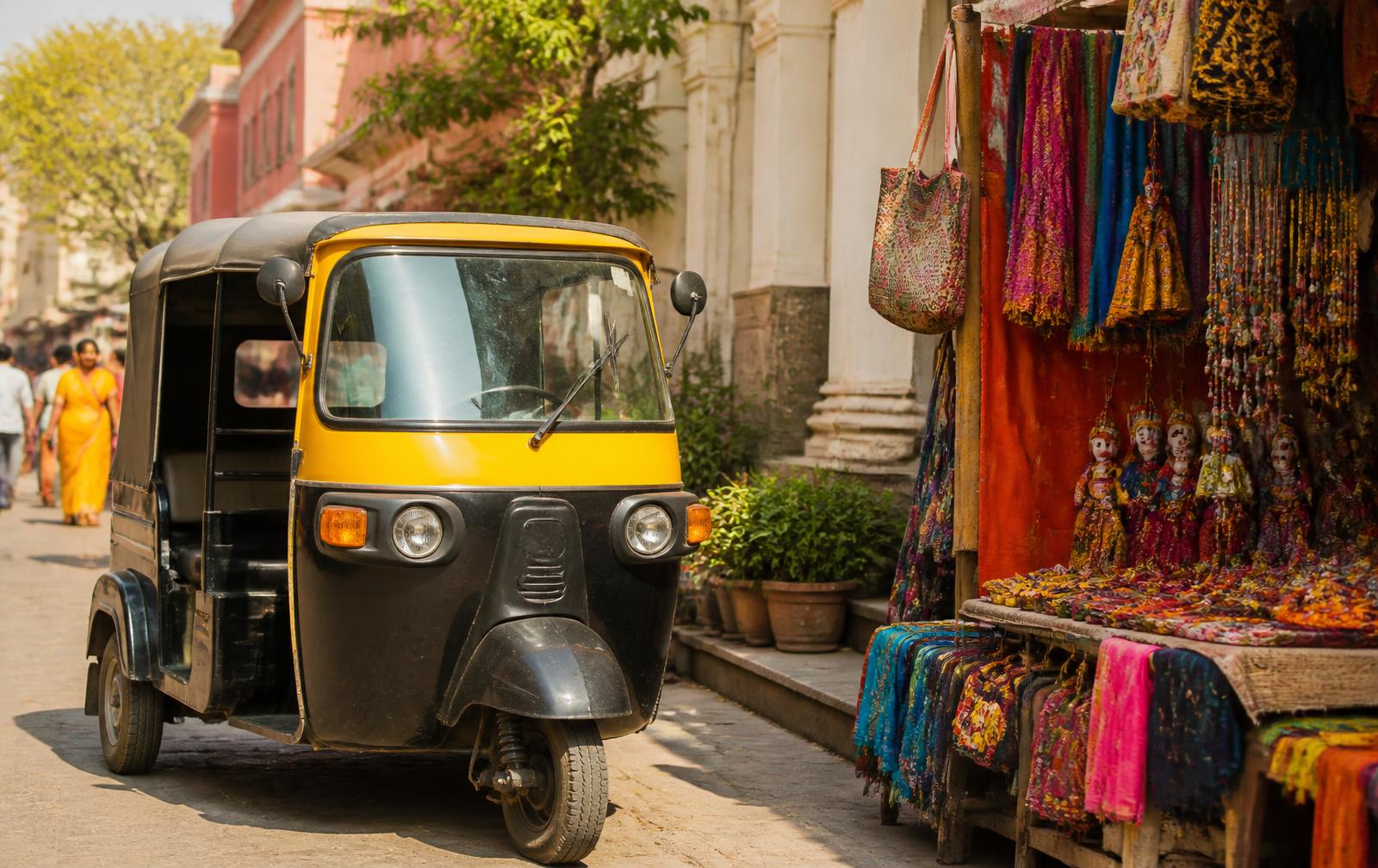
There is no single fair rickshaw fare in India, because fare culture changes city by city. In Mumbai, drivers run the meter and hand back your change. In Bengaluru, the price quoted to a visitor is usually not the local price. Your benchmark anywhere is the fare estimate on a ride-hailing app.
What should I expect in Bengaluru?
Assume the first quote is the tourist rate, and counter it. The driver may refuse and drive off. Let him. There are plenty of auto rickshaws behind him, and every exchange teaches you the real range, so your third negotiation will be sharper than your first. Two practical notes: agree on the fare before you get in, and carry small bills, because extra money handed over tends to be kept as a tip without anyone asking you.
What should I expect in Mumbai?
Mumbai's rickshaw and taxi drivers are, in my experience, the most matter-of-fact in the country. They use the meter without being asked, and if you hand over more than the fare, they count out your change and return it. Mumbai gets compared to New York often, and its cab culture is part of why the comparison holds.
Which ride-hailing apps work in India?
Uber and Ola cover the major cities. Alongside them, as of August 2026, there is a newer generation of zero-commission apps where the driver keeps the whole fare: Namma Yatri, which started in Bengaluru, and Bharat Taxi, a cooperative-run platform launched with government backing in February 2026 with no commission and no surge pricing. The practical benefit is the same on all of them: the price appears on your screen before anyone can quote you a tourist rate. Even when I plan to hail a rickshaw on the street, I open an app first just to see what the ride should cost.
What to expect by city
| City | What to expect from street rickshaws and taxis |
|---|---|
| Bengaluru | The first quote to a visitor is usually above the local rate. Agree on the fare before you get in, counter the first number, and carry small bills. Extra money handed over tends to be kept as a tip. |
| Mumbai | Drivers run the meter without being asked and count your change back to you. Pay what the meter says plus a small tip if you like. |
| Any major city | Open a ride-hailing app before you travel anywhere. The upfront price on the screen is your benchmark, whether you book through the app or hail a ride on the street. |
Am I supposed to haggle in India?
Yes, in street markets and with street vendors, where the first price offered to a visitor is usually padded. No, in malls, branded shops, and anywhere with printed price tags, where prices are fixed retail, the same as in the US. In the right setting, haggling is expected, not rude.
My own method is unscientific and it works: counter somewhere around half, settle in the middle, and keep it light. Walking away is a legitimate move, and often the exact moment the price improves. One useful backstop: packaged goods in India carry a printed MRP, the maximum retail price, on the label. No one should charge above it, and that includes the bottle of water at a tourist site.
And decide in advance what a win means. If you're negotiating over the difference of a dollar, the vendor arguably needs it more than your pride does. Haggle for the fairness and the sport, not the last rupee.
How do I protect myself from pickpockets on trains and in crowds?
The same way you would in Rome or Barcelona. Pickpocketing in India concentrates where crowds do: railway stations, trains, busy markets, festivals. A cross-body bag that zips, a wallet that never rides in a back pocket, and luggage that is never left unattended remove most of the opportunity.
Trains deserve one extra habit. On overnight routes, Indian travelers themselves secure their bags under the berth, often with a small cable lock, and it's worth copying them. None of this is India-specific advice, and that is the point. This part of the risk is the ordinary, manageable kind that comes with every crowded, famous place on earth.
Who do I ask for help if something feels wrong?
Ask a uniform. Traffic police stand at major intersections, and security guards are posted at metro stations, malls, banks, and hotel doors across urban India. In most cases they will point you the right way, and someone nearby usually steps in to translate. People in India help fast, and visibly.
Here is the distinction worth memorizing: the help you seek out is almost always real, and the help that finds you first is the thing to filter. A guard you approach has no angle. A stranger who approaches you might. That single rule sorts most situations correctly.
Will I still get overcharged sometimes?
Probably, yes. I still pay the outsider's price now and then in cities I don't know well, and I was born in the country. The difference is scale. Most India tourist scams are really just overcharging with confidence, and the markup on a rickshaw or a souvenir is usually a dollar or two. Budget a little being-wrong into the trip and it loses the power to ruin an afternoon.
What I can't give you is a clean price list, because fair prices in India shift by city, season, and neighborhood, and any table I published today would mislead you by winter. What I can give you is the benchmark habit, the haggling settings, and the pre-booking rule. Those hold everywhere.
Common Questions About India Tourist Scams
Are tourist scams in India dangerous?
Almost never. They target your wallet and your time, not your person. Persistence can feel aggressive if you've never experienced it, but a firm no and continued walking ends nearly every encounter.
Is it rude to haggle in India?
No. In street markets it's the expected way business gets done, and vendors build room for it into the first price. Keep it good-humored, and pay the fixed price without negotiating in malls, restaurants, and shops with printed tags.
Should I use Uber in India, or the local apps?
Both work. Uber and Ola cover the major cities, and zero-commission apps like Namma Yatri and Bharat Taxi are growing quickly as of 2026. Whichever you choose, the upfront fare on the screen is the honest benchmark that street negotiation never gives you.
What if a driver refuses to use the meter?
Walk to the next rickshaw or taxi. There is nearly always a next one. In Mumbai the meter is the norm. Elsewhere, agree on the full price before you get in, or skip the negotiation entirely and book through an app.
What should I do if I realize I've been scammed?
If the loss is a few dollars, let it go and don't let it recolor the day. If it's a real theft or something larger, go to your hotel front desk first. Staff handle these situations often, know the local process, and can help you reach the police if a report is needed.
None of this asks you to spend your trip on guard. It asks for a plan for the first 48 hours, a fare benchmark on your phone, and a comfortable, unapologetic no. India will meet you more than halfway after that.
If you want someone to look at your actual dates and your actual worries and tell you what is realistic, that is what I do. And if you're not ready to plan yet, I send honest India travel tips by email. No hype, no countdowns.